
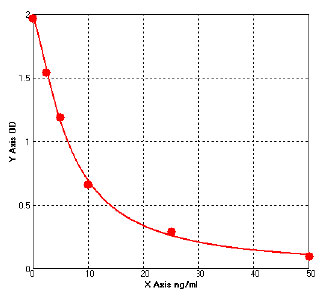
 Standard Curve (Sample)
(Typical Standard Curve for ABCD3 ELISA (Sandwich))
Standard Curve (Sample)
(Typical Standard Curve for ABCD3 ELISA (Sandwich))
Human ATP Binding Cassette Transporter D3 (ABCD3) ELISA Kit | ABCD3 elisa kit
Human ATP Binding Cassette Transporter D3 (ABCD3) ELISA Kit
Gene Names
ABCD3; ZWS2; ABC43; PMP70; PXMP1
Reactivity
Human
Synonyms
ATP Binding Cassette Transporter D3 (ABCD3); N/A; Human ATP Binding Cassette Transporter D3 (ABCD3) ELISA Kit; ABCD3 ELISA kit (Human); ABC-D3; PXMP1; ABC43; PMP70; ZWS2; 70 kDa peroxisomal membrane protein; ATP-binding cassette sub-family D member 3; ABCD3 elisa kit
Reactivity
Human
Specificity
This assay has high sensitivity and excellent specificity for detection of ATP Binding Cassette Transporter D3 (ABCD3). No significant cross-reactivity or interference between ATP Binding Cassette Transporter D3 (ABCD3) and analogues was observed.
Reactive with Human ABCD3/ATP Binding Cassette Transporter D3
Reactive with Human ABCD3/ATP Binding Cassette Transporter D3
Assay Type
Double-antibody Sandwich
Samples
Tissue homogenates, Cell lysates and other biological fluids
Detection Method
Colormetric
Featured Series
SE kit
Detection Range
0.156-10ng/mL
Sensitivity
0.058ng/mL
Sample Size
100uL
Assay Time
3h
Function
Detects protein (regular version)
Precision
Intra-assay Precision (Precision within an assay): 3 samples with low, middle and high level ATP Binding Cassette Transporter D3 (ABCD3) were tested 20 times on one plate, respectively.
Inter-assay Precision (Precision between assays): 3 samples with low, middle and high level ATP Binding Cassette Transporter D3 (ABCD3) were tested on 3 different plates, 8 replicates in each plate.
CV(%) = SD/meanX100
Intra-Assay: CV<10%, Inter-Assay: CV<12%
Inter-assay Precision (Precision between assays): 3 samples with low, middle and high level ATP Binding Cassette Transporter D3 (ABCD3) were tested on 3 different plates, 8 replicates in each plate.
CV(%) = SD/meanX100
Intra-Assay: CV<10%, Inter-Assay: CV<12%
Assay Procedure Summary
1. Prepare all reagents, samples and standards
2. Add 100ul standard or sample to each well. Incubate 2 hours at 37 degree C
3. Aspirate and add 100ul prepared Detection Reagent A. Incubate 1 hour at 37 degree C
4. Aspirate and wash 3 times
5. Add 100ul prepared Detection Reagent B. Incubate 30 minutes at 37 degree C
6. Aspirate and wash 5 times
7. Add 90ul Substrate Solution. Incubate 10-20 minutes at 37 degree C
8. Add 50ul Stop Solution. Read at 450nm immediately.
2. Add 100ul standard or sample to each well. Incubate 2 hours at 37 degree C
3. Aspirate and add 100ul prepared Detection Reagent A. Incubate 1 hour at 37 degree C
4. Aspirate and wash 3 times
5. Add 100ul prepared Detection Reagent B. Incubate 30 minutes at 37 degree C
6. Aspirate and wash 5 times
7. Add 90ul Substrate Solution. Incubate 10-20 minutes at 37 degree C
8. Add 50ul Stop Solution. Read at 450nm immediately.
Test Principle
The test principle applied in this kit is Sandwich enzyme immunoassay. The microtiter plate provided in this kit has been pre-coated with an antibody specific to ATP Binding Cassette Transporter D3 (ABCD3). Standards or samples are then added to the appropriate microtiter plate wells with a biotin-conjugated antibody specific to ATP Binding Cassette Transporter D3 (ABCD3). Next, Avidin conjugated to Horseradish Peroxidase (HRP) is added to each microplate well and incubated. After TMB substrate solution is added, only those wells that contain ATP Binding Cassette Transporter D3 (ABCD3), biotin-conjugated antibody and enzyme-conjugated Avidin will exhibit a change in color. The enzyme-substrate reaction is terminated by the addition of sulphuric acid solution and the color change is measured spectrophotometrically at a wavelength of 450nm +/- 10nm. The concentration of ATP Binding Cassette Transporter D3 (ABCD3) in the samples is then determined by comparing the O.D. of the samples to the standard curve.
Research Area
Signal transduction
Preparation and Storage
Store at 4 degree C for 1 month/-20 degree C for long-term (One year within shelf life)
The stability of kit is determined by the loss rate of activity. The loss rate of this kit is less than 5% within the expiration date under appropriate storage condition.To minimize extra influence on the performance, operation procedures and lab conditions, especially room temperature, air humidity, incubator temperature should be strictly controlled. It is also strongly suggested that the whole assay is performed by the same operator from the beginning to the end.
The stability of kit is determined by the loss rate of activity. The loss rate of this kit is less than 5% within the expiration date under appropriate storage condition.To minimize extra influence on the performance, operation procedures and lab conditions, especially room temperature, air humidity, incubator temperature should be strictly controlled. It is also strongly suggested that the whole assay is performed by the same operator from the beginning to the end.
Standard Curve (Sample)
(Typical Standard Curve for ABCD3 ELISA (Sandwich))
Standard Curve (Sample)
(Typical Standard Curve for ABCD3 ELISA (Sandwich))
NCBI and Uniprot Product Information
NCBI GI #
NCBI GeneID
Molecular Weight
27,121 Da
NCBI Official Full Name
ATP-binding cassette sub-family D member 3
NCBI Official Synonym Full Names
ATP-binding cassette, sub-family D (ALD), member 3
NCBI Official Symbol
ABCD3
NCBI Official Synonym Symbols
ZWS2; ABC43; PMP70; PXMP1
NCBI Protein Information
ATP-binding cassette sub-family D member 3; 70 kDa peroxisomal membrane protein; Peroxisomal membrane protein-1 (70kD); peroxisomal membrane protein 1 (70kD, Zellweger syndrome); dJ824O18.1 (ATP-binding cassette, sub-family D (ALD), member 3 (PMP70, PXMP1
UniProt Protein Name
ATP-binding cassette sub-family D member 3
UniProt Gene Name
ABCD3
UniProt Synonym Gene Names
PMP70; PXMP1; PMP70
UniProt Entry Name
ABCD3_HUMAN
Similar Products






Product Notes
The Human ABCD3 abcd3 (Catalog #AAA161534) is an ELISA Kit and is intended for research purposes only. The product is available for immediate purchase. The AAA161534 ELISA Kit recognizes Human ABCD3. It is sometimes possible for the material contained within the vial of "ATP Binding Cassette Transporter D3 (ABCD3), ELISA Kit" to become dispersed throughout the inside of the vial, particularly around the seal of said vial, during shipment and storage. We always suggest centrifuging these vials to consolidate all of the liquid away from the lid and to the bottom of the vial prior to opening. Please be advised that certain products may require dry ice for shipping and that, if this is the case, an additional dry ice fee may also be required.Precautions
All products in the AAA Biotech catalog are strictly for research-use only, and are absolutely not suitable for use in any sort of medical, therapeutic, prophylactic, in-vivo, or diagnostic capacity. By purchasing a product from AAA Biotech, you are explicitly certifying that said products will be properly tested and used in line with industry standard. AAA Biotech and its authorized distribution partners reserve the right to refuse to fulfill any order if we have any indication that a purchaser may be intending to use a product outside of our accepted criteria.Disclaimer
Though we do strive to guarantee the information represented in this datasheet, AAA Biotech cannot be held responsible for any oversights or imprecisions. AAA Biotech reserves the right to adjust any aspect of this datasheet at any time and without notice. It is the responsibility of the customer to inform AAA Biotech of any product performance issues observed or experienced within 30 days of receipt of said product. To see additional details on this or any of our other policies, please see our Terms & Conditions page.Item has been added to Shopping Cart
If you are ready to order, navigate to Shopping Cart and get ready to checkout.